


AI is already changing software delivery. Developers are using it to write code. Business analysts are using it to structure requirements. QA teams are using it to generate test cases. Architects are using it to challenge designs.
This is no longer a future concept. AI in enterprise software development is already embedded within delivery teams today.
But there is also a credibility problem.
Many teams are still using AI through what we often call “vibe coding.” Someone gives an AI tool a loose instruction, accepts the output, adjusts a few things, and moves forward quickly. It feels fast. It can look impressive. Sometimes it even works. But the vibe-coding risks enterprise environments cannot be ignored. In enterprise software delivery, that is not enough.
Clients expect more than just lucky outputs. They look forward to a reliable systems, secure applications, clear decisions, proper documentation, and accountable delivery. This is why we need to think about AI differently.
Why Vibe Coding is not enough for enterprise software delivery
AI is not a magic wand. It is not a senior engineer who understands the business, architecture, security, compliance, and client expectations from day one.
A better way to look at AI is to view it as a capable junior resource that can learn and contribute. A good junior developer can be highly productive, but only with the right context, guidance, standards, review, and feedback. Without that structure, a junior developer may misunderstand requirements, miss edge cases, create an incomplete feature, or solve the wrong problem confidently. AI behaves in a similar way.
Many of the mistakes that AI makes are often the same mistakes an emerging developer would make. It can misunderstand the business requirement, generate code that works technically, but does not solve the actual user needs. It can overlook security considerations, lose important context, or create documentation that sounds convincing but lacks accuracy.
The difference is that AI can make these mistakes much faster and at a much larger scale if there is no control around it.
So, the question is not whether AI makes mistakes.
The real question is whether we have a system that can guide it, review it, train it, and control it.
That is the thinking behind SELISE Mad-P: Multi-Agent Delivery Pipeline.
Introducing SELISE Mad-P: multi-agent delivery pipeline
Mad-P is a human-agent collaboration network designed for software delivery. It is not just an AI coding tool. It is not a random collection of prompts. It is a structured AI delivery pipeline where specialist AI agents work with humans across the software delivery lifecycle.
In a standard delivery team, everyone works on a chain of distinct roles and responsibilities. One person shapes the business’s needs; another maps out the product requirements, while others handle planning, development, testing, security, compliance, and documentation. Finally, someone signs off on the release.
Mad-P follows the same delivery logic but adds AI agents into the process in a controlled and repeatable way.
Mad-P agent network includes:
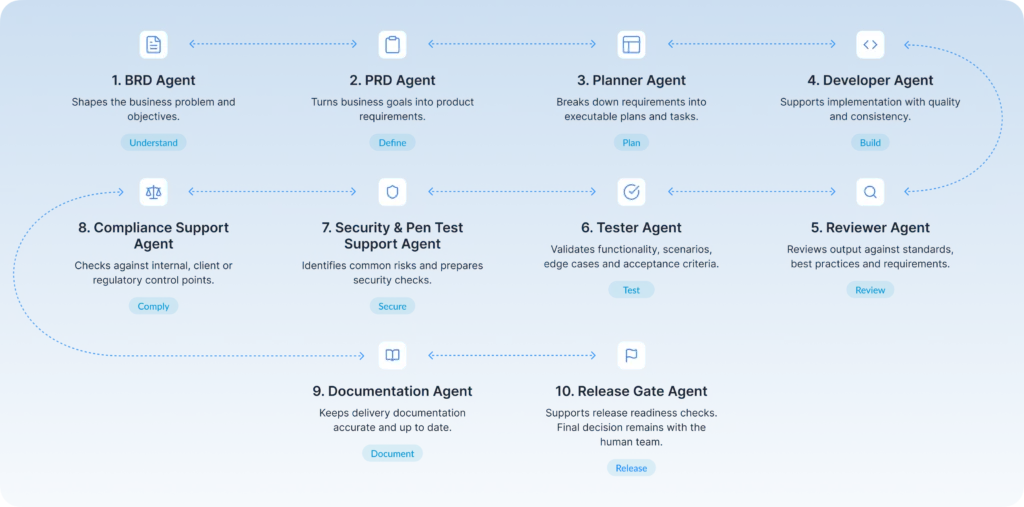
| Agent | Role in the Delivery Lifecycle |
| BRD Agent | The BRD Agent helps shape the business problem clearly. |
| PRD Agent | The PRD Agent AI turns that into product-level requirements. |
| Planner Agent | The Planner Agent breaks the work into executable tasks. |
| Developer Agent | The Developer Agent supports implementation. |
| Reviewer Agent | The Reviewer Agent checks the output against defined standards. |
| Tester Agent | The AI Tester Agent validates scenarios, edge cases, and acceptance criteria. |
| Security & Pen Test Support Agent | The Security & Pen Test Support Agent helps identify common risks and prepare security checks. |
| Compliance Support Agent | The Compliance Support Agent checks against defined internal, client, or regulatory control points. |
| Documentation Agent | The AI Documentation Agent keeps the delivery record clean. |
| Release Gate Agent | Supports release readiness reviews and deployment decisions |
Why structured AI delivery matters
This structure matters because enterprise delivery is not only about producing code. It is about producing confidence.
Confidence comes from total visibility: knowing why something was built, what requirement it came from, what was reviewed, what was tested, what risks were found, what was approved, and what still needs attention. In traditional delivery, tracking all of this heavily depends on individual discipline, experience, and memory.
Mad-P turns that knowledge into a repeatable delivery process that improves consistency, quality, and governance across projects.
Mad-P is already being applied across multiple SELISE product initiatives, where early teams are seeing efficiency gains in requirement structuring, task preparation, development support, test coverage, documentation, and review preparation. The value is not only faster coding. The bigger value is that delivery becomes more structured, more traceable, and easier to control following enterprise delivery standards.
Scenarios of the Mad-P application
Improving requirement quality
A product team can use the BRD and PRD Agents to turn a raw business idea into a clearer delivery scope.
The Planner Agent can then break that scope into stories and tasks. The Developer Agent can support implementation based on those tasks, while the Reviewer and Tester Agents check whether the output meets the expected standard. This reduces the back-and-forth that usually happens when requirements are unclear or when development starts before product thinking is mature.
Strengthening release readiness
A team preparing for release can use the Tester, Security, Compliance, Documentation, and Release Gate Agents to strengthen final delivery checks. Instead of relying only on manual checklists or last-minute reviews, the pipeline can help identify gaps earlier and make the release decision more evidence-based.
Flexible adoption across teams
Mad-P is also not an all-or-nothing framework. Not every team has to use every agent from day one.
A team may start with the BRD and PRD Agents if their biggest challenge is requirement clarity. Another team may start with the Developer, Reviewer, and Tester Agents if their immediate focus is engineering productivity.
A regulated product may prioritize Security, Compliance, Documentation, and Release Gate support. Teams can pick and choose based on their maturity, product type, delivery pressure, and risk profile. However, for the best result, we recommend that teams eventually move toward the full pipeline.
The real power of Mad-P comes when the agents work together across the delivery lifecycle. A BRD should flow into a PRD. A PRD should flow into planning. Planning should guide development. Development should be reviewed, tested, checked for security, documented, and passed through release readiness. When the full chain is connected, the output becomes more consistent, and the feedback loop becomes stronger.
Human-in-the-Loop (HITL) vs Human-on-the-Loop (HOTL)
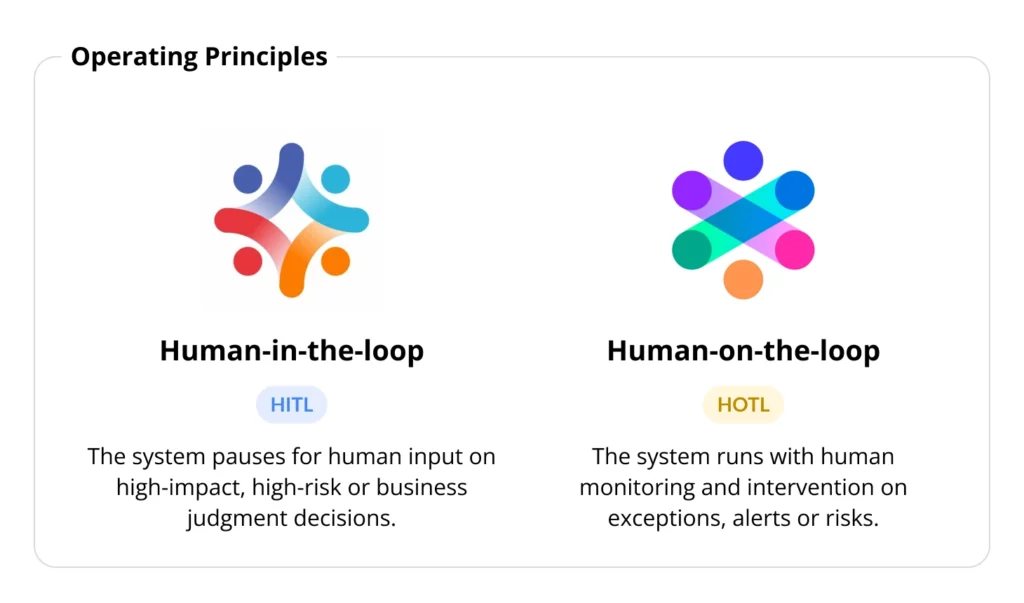
Mad-P is built around two operating principles: Human-in-the-Loop and Human-on-the-Loop to balance and deliver responsible AI delivery.
Human-in-the-Loop (HITL)
Human-in-the-Loop, or HITL, means the system pauses and waits for human input. This is needed when a decision is high-impact, high-risk, or requires business judgment. For example, approving a BRD, finalizing a PRD, accepting a security exception, approving a compliance-sensitive workflow, or giving the final release go-ahead should not be left entirely to automation. In these moments, the human acts as an active reviewer or approver.
Human-on-the-Loop (HOTL)
Human-on-the-Loop, or HOTL, works differently. Here, the system can continue to operate while humans monitor the process and step in when there is an exception, alert, or risk. This is useful for scalable activities such as test generation, documentation updates, coding support, basic review checks, regression analysis, and routine validation. Humans do not need to approve every small step, but they remain in control when something crosses a defined threshold.
This balance is important. If everything is HITL, delivery becomes slow because every step waits for human approval.
If everything is HOTL, the risk becomes too high because the system may move fast without enough control.
Mad-P uses both models. Humans stay directly involved where accountability is needed, while automation supports work that is repetitive, structured, and measurable.
Model flexibility and cost optimization
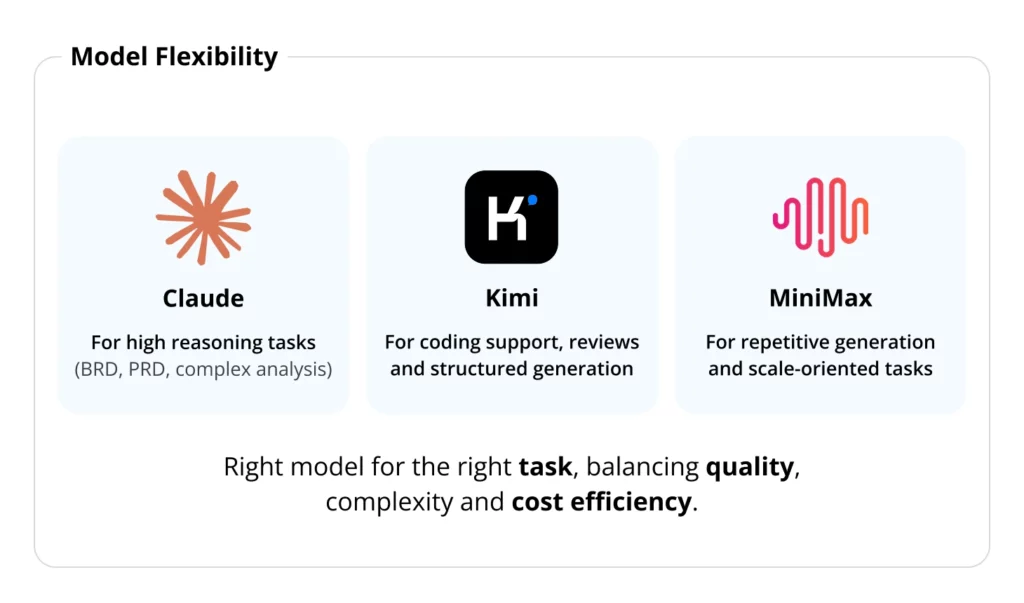
Another important part of Mad-P is model flexibility. The models behind the agents do not all have to be the same.
We have considered token consumption, output quality, task complexity, and cost efficiency while designing the pipeline. Some tasks need stronger reasoning and better quality output. For example, the BRD and PRD generation may benefit from a more advanced model such as Claude because the quality of business and product thinking matters heavily at that stage.
But coding support, review preparation, or repetitive generation work may be handled by other configurable models such as Kimi or MiniMax, depending on the use case, cost target, and performance requirement.
This is a practical design choice. Using the most expensive model for every task is not always necessary. At the same time, using a cheaper model for complex business analysis may reduce quality.
Mad-P allows teams to configure the right model for the right agent. That gives the organization better control over quality, cost, and scalability.
This is why Mad-P should not be seen only as an AI experiment. It is an operating model for AI-assisted enterprise delivery. It helps SELISE capture delivery knowledge and turn it into repeatable practice. Today, most of the delivery quality depends on experienced people remembering what to check. Experienced practitioners inherently understand project vulnerabilities, what could go wrong, client expectations during UAT, and the long-term liabilities of technical debt.
Mad-P helps to convert that experience into a structured system. The standards become reusable. The checks become repeatable, and feedback becomes part of the process. The agents become better over time because they are operating inside a guided network, not in isolation.
The future of human-agent collaboration
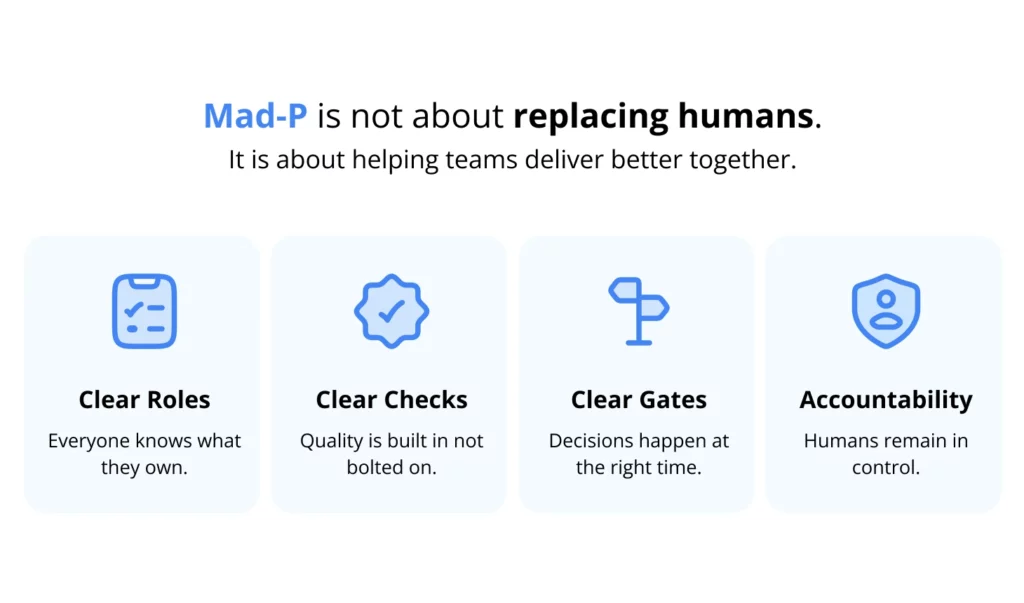
Mad-P is not about replacing delivery teams. It is an AI delivery operating model designed to improve software delivery quality control, governance, and delivery confidence. Humans remain connected throughout the network: they provide approval when needed, monitor workflows, override where the risk is too high, and refine the models with continuous feedback . Humans continue to drive business decisions, manage client relationships, and hold ultimate accountability.
That is the difference between random AI usage and a real human-agent collaboration network. Vibe coding may create fast demos but Mad-P is designed to support serious delivery.
Vibe coding treats AI like magic. Mad-P treats AI as a capable junior resource inside a disciplined delivery system.
AI will change software delivery. But companies that use it carelessly may create technical debt, security gaps, weak documentation, and credibility problems. Companies that use it with structure can move faster without losing control. Mad-P is SELISE’s step toward that structured future. A human-agent collaboration network where people and agents work together, with clear roles, clear checks, clear gates, configurable models, and clear accountability.
That is how organizations build AI delivery credibility and prepare for the realities of enterprise software delivery in 2026.
Ready to build structured AI-assisted delivery?
Mad-P represents SELISE’s approach to building enterprise-ready human-agent collaboration systems that improve delivery outcomes without sacrificing quality, security, or control.
Contact SELISE to learn how the principles behind Mad-P can help your organization build and operate AI-powered delivery workflows with confidence.
