

Penetration Testing
Penetration Testing
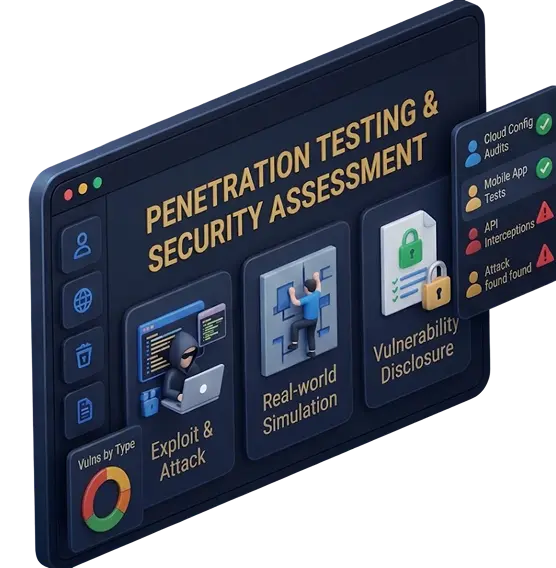
Identify exploitable security weaknesses before attackers do. SELISE conducts controlled, real-world penetration testing to simulate advanced cyberattacks across applications, networks, APIs, cloud environments, and mobile platforms. Using a combination of manual testing techniques and modern attack methodologies, the assessment uncovers vulnerabilities such as authentication weaknesses, injection flaws, insecure configurations, privilege escalation risks, and business logic issues. The engagement helps organizations understand real attack paths, assess potential business impact, and strengthen overall security resilience.
Service Areas
Mobile Application VAPT
Comprehensive security assessment of Android and iOS applications performed in alignment with the OWASP Mobile Application Security Testing Guide (MASTG), focusing on identifying vulnerabilities across application binaries, APIs, authentication mechanisms, data storage and communication channels.
Web Applications Vulnerability Assessment and Penetration Testing (VAPT)
Web Application VAPT (Vulnerability Assessment and Penetration Testing) is a comprehensive security evaluation of web applications to identify and exploit potential vulnerabilities before attackers can misuse them. It combines automated scanning and manual testing techniques to assess issues such as authentication flaws, injection vulnerabilities, broken access controls, insecure configurations, and business logic weaknesses.
API Security Testing
API Security Testing is a focused security assessment of application programming interfaces (APIs) such as REST, GraphQL, and SOAP to identify vulnerabilities that could expose sensitive data or enable unauthorized actions. It involves evaluating authentication and authorization mechanisms, input validation, rate limiting, and data exposure risks to detect issues like broken access control, injection flaws, insecure object references, and excessive data exposure based on OWASP API testing guidelines.
Network Penetration Testing
Network Penetration Testing is a security assessment of an organization’s internal and external network infrastructure to identify vulnerabilities that could be exploited by attackers. It involves evaluating network devices, servers, firewalls, and services to detect issues. The testing also simulates real-world attack scenarios, including lateral movement and privilege escalation, to assess the potential impact of a breach.
Secure Code Review & Dependency Analysis
Strengthen your application’s security posture by identifying vulnerabilities in both your own code and third-party components. Our review combines expert-led source code analysis with Software Composition Analysis (SCA) to detect security flaws, vulnerable dependencies, outdated packages, and open-source risks before they impact your applications with security and supply chain risks.
Cloud Infrastructure Assessment
Cloud Security Assessments evaluate cloud environments like AWS, Azure, and GCP to identify misconfigurations, weak access controls, exposed services, and security risks. The assessment reviews IAM, network configurations, storage, and logging using frameworks such as CIS Benchmarks, NIST CSF, and CSA CCM. It helps simulate real-world attack scenarios and provides actionable recommendations to improve cloud security posture and ensure compliance.